General Form of a System of Equations
Standard representation of linear systems
- 2×2 System: ax + by = c, dx + ey = f
- 3×3 System: ax + by + cz = d, ex + fy + gz = h, ix + jy + kz = l
- Solution: Values of variables that satisfy all equations simultaneously
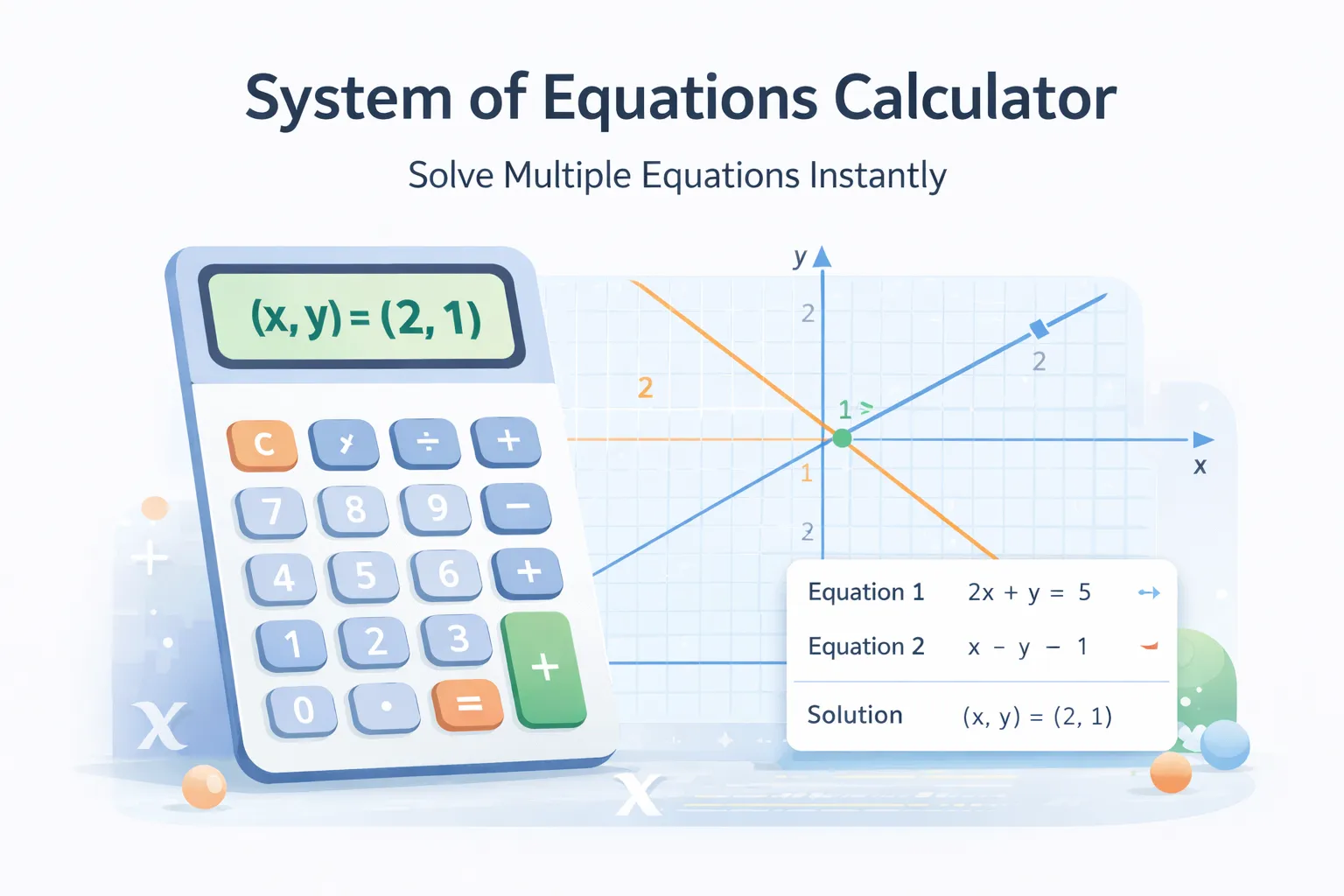
🧮 System of Equations Calculator (How It Works)
This calculator helps you:
- Solve 2×2 and 3×3 systems
- Get step-by-step solutions
- Identify the type of solution
- Use multiple solving methods automatically
Inputs:
Linear equations (e.g., 2x + y = 5)
Outputs:
- Values of variables (x, y, z)
- Step-by-step breakdown
- Solution type (unique, none, infinite)
🧠 Methods to Solve Systems of Equations
🔹 1. Substitution Method
Best when one equation is easy to rearrange.
Steps:
- Solve one equation for a variable
- Substitute into the other equation
- Solve and back-substitute
Example:
x + y = 10
x − y = 2
👉 Solve first equation: x = 10 − y
Substitute into second: (10 − y) − y = 2
👉 y = 4, x = 6
🔹 2. Elimination Method (Fastest)
Best when coefficients align.
Steps:
- Add or subtract equations
- Eliminate one variable
- Solve remaining equation
Example:
x + y = 10
x − y = 2
Add both:
👉 2x = 12 → x = 6 → y = 4
🔹 3. Matrix Method (Advanced)
Used for larger systems (especially 3×3).
- Uses matrices and determinants
- Often solved using calculators or software
- Most efficient for 3×3 and larger systems
Step-by-Step Example (Featured Snippet Ready)
Solve using elimination method
📊 Types of Solutions
1. One Solution (Consistent)
Lines intersect at one point
The system has a unique solution where all equations are satisfied simultaneously.
2. No Solution (Inconsistent)
Parallel lines (never meet)
The equations represent parallel lines or planes that never intersect.
3. Infinite Solutions
Same line (identical equations)
The equations represent the same line or plane, resulting in infinite solutions.
📉 How Many Solutions Does a System Have?
| Type | Result |
|---|---|
| Consistent | One or infinite solutions |
| Inconsistent | No solution |
🧠 How to Use This Calculator Effectively
Input Format
Use standard linear form:
2x + y = 5
x − 3y = 7
Pro Tips
- Simplify equations first
- Avoid decimals when possible
- Use parentheses for clarity
- Check your solution by substituting back
🧮 Solve Using a Graphing Calculator
Steps:
- Enter equations into graph mode
- Plot both lines
- Find intersection point
👉 That intersection is the solution.
📈 Real-Life Applications
Systems of equations are used in:
- Economics - Supply & demand curves, market equilibrium
- Engineering - Circuit analysis, structural calculations
- Physics - Motion problems, force analysis
- Business - Break-even analysis, profit optimization
- Chemistry - Mixture problems, reaction balancing
- Budgeting and planning - Resource allocation, cost analysis
❓ FAQs (AEO Optimized)
What is a system of equations calculator?
A system of equations calculator is a tool that solves multiple equations with shared variables automatically. It finds the values of variables (like x, y, z) that satisfy all equations simultaneously, showing step-by-step solutions using methods like substitution, elimination, or matrices.
What is the fastest method to solve a system of equations?
Elimination is usually the fastest method for simple 2×2 systems, especially when coefficients align easily. For 3×3 systems or larger, matrix methods (like Gaussian elimination or Cramer's rule) are more efficient. Substitution works best when one equation is already solved for a variable.
Can a system of equations have no solution?
Yes, a system has no solution when the equations represent parallel lines (in 2D) or parallel planes (in 3D) that never intersect. This is called an inconsistent system. For example, 2x + y = 5 and 2x + y = 10 are parallel lines with no common solution.
Can I solve systems with 3 variables?
Yes, you can solve 3-variable systems (3×3) using elimination, substitution, or matrix methods. Matrix methods like Gaussian elimination or Cramer's rule are most efficient for 3×3 systems. The calculator handles both 2×2 and 3×3 systems automatically.
Why use a calculator for systems of equations?
A calculator saves time, reduces arithmetic errors, and provides step-by-step explanations that help you learn the solving process. It's especially useful for complex systems, checking homework, or understanding different solution methods.
How many solutions can a system of equations have?
A system can have: (1) One unique solution - lines/planes intersect at one point (consistent), (2) No solution - parallel lines/planes never meet (inconsistent), or (3) Infinite solutions - equations represent the same line/plane (dependent system).
What is the substitution method?
The substitution method solves one equation for a variable, then substitutes that expression into the other equation(s). It's best when one equation is easy to rearrange. Example: From x + y = 10, get x = 10 - y, then substitute into the second equation.
What is the elimination method?
The elimination method adds or subtracts equations to eliminate one variable, making it easier to solve. It's fastest when coefficients align. Example: Adding x + y = 10 and x - y = 2 eliminates y, giving 2x = 12, so x = 6.
What are real-life applications of systems of equations?
Systems of equations are used in economics (supply and demand curves), engineering (circuit analysis, structural calculations), physics (motion problems), business (break-even analysis), chemistry (mixture problems), and everyday budgeting and planning scenarios.