What Is a Quadratic Formula Calculator?
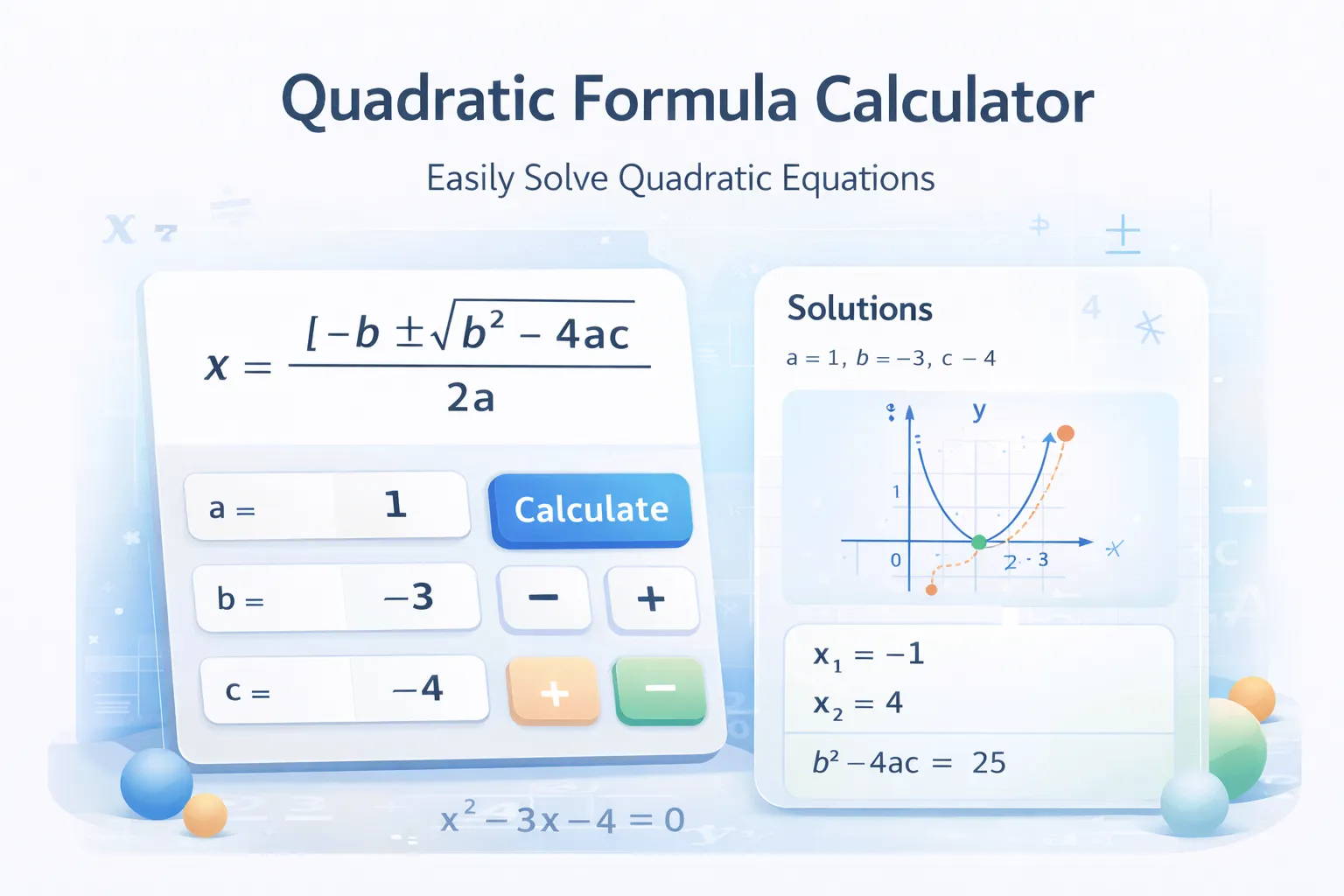
A quadratic formula calculator is a powerful tool that solves quadratic equations in the form ax² + bx + c = 0 instantly and accurately. Whether you're a student tackling algebra homework, a professional engineer solving complex problems, or anyone needing quick solutions, this calculator eliminates manual calculation errors and saves valuable time.
With over 49,000 monthly searches for "quadratic formula calculator," it's clear that people need fast, reliable solutions for quadratic equations. Our calculator provides:
- Instant solutions: Get both roots (x₁ and x₂) in milliseconds
- Step-by-step explanations: Understand every calculation step
- Discriminant analysis: Know if solutions are real or complex
- Real and complex roots: Handles all types of quadratic equations
- Visual insights: Understand what the solutions mean graphically
Quick Tip:
The quadratic formula works for ANY quadratic equation, even when factoring is impossible or difficult. It's the most reliable method for solving ax² + bx + c = 0.
The Quadratic Formula Explained
The quadratic formula is one of the most important formulas in algebra. It provides a systematic way to find the solutions (roots) of any quadratic equation.
What Do a, b, and c Mean?
In the standard form ax² + bx + c = 0:
- a = coefficient of x² (the quadratic term, must not be zero)
- b = coefficient of x (the linear term)
- c = constant term (the number without a variable)
Understanding the ± Symbol
The ± (plus-minus) symbol means you calculate two solutions:
- x₁ = (-b + √(b² - 4ac)) / (2a) — using the plus sign
- x₂ = (-b - √(b² - 4ac)) / (2a) — using the minus sign
Example:
For x² - 5x + 6 = 0: a=1, b=-5, c=6
x = (5 ± √1) / 2 = (5 ± 1) / 2
Solutions: x₁ = 3 and x₂ = 2
How to Use a Quadratic Formula Calculator (Step-by-Step)
Using our quadratic formula calculator is simple and intuitive. Follow these steps to solve any quadratic equation:
- Write your equation in standard form: Rearrange to ax² + bx + c = 0
- Identify the coefficients: Determine values of a, b, and c
- Enter the values: Input a, b, and c into the calculator fields
- View instant results: See both solutions (x₁ and x₂) immediately
- Review step-by-step solution: Understand how the answer was calculated
- Check the discriminant: Understand the nature of your solutions
💡 Pro Tips for Using the Calculator:
- ✓ Always check that 'a' is not zero (otherwise it's not a quadratic equation)
- ✓ Use negative signs correctly (e.g., if b is negative, enter -5 not 5)
- ✓ Decimal values are accepted (e.g., a=1.5, b=-2.7, c=3.2)
- ✓ Try the preset examples to see how different equations behave
- ✓ Check the discriminant to predict solution types before calculating
Example: Solve a Quadratic Equation
Let's walk through a complete example solving x² - 5x + 6 = 0 using the quadratic formula.
Given Equation: x² - 5x + 6 = 0
How to Calculate Quadratic Formula Manually
While calculators are faster, understanding the manual process helps you grasp the concept. Here's how to calculate the quadratic formula step-by-step by hand:
- Write equation in standard form (ax² + bx + c = 0) Rearrange all terms to one side, leaving zero on the other
- Identify coefficients a, b, and c Be careful with negative signs and missing terms (if no x term, b=0)
- Calculate the discriminant: b² - 4ac This tells you if solutions are real or complex
- Calculate -b (the opposite of b) If b is negative, -b becomes positive
- Calculate √(discriminant) If negative, you'll have complex solutions with 'i'
- Calculate 2a (two times a) This is your denominator for both solutions
- Calculate both solutions: x₁ = (-b + √discriminant) / (2a)x₂ = (-b - √discriminant) / (2a)
- Simplify and verify Plug solutions back into original equation to check
⚠️ Common Mistakes to Avoid:
- • Forgetting the negative sign in -b
- • Misplacing parentheses in calculations
- • Incorrect square root calculations
- • Not simplifying fractions fully
- • Confusing the ± symbol (you need BOTH solutions)
- • Dividing only part of the numerator by 2a
How to Put Quadratic Formula in Calculator (TI-84 & Scientific)
Different calculators have different methods for solving quadratic equations. Here's how to use the most common types:
TI-84 Calculator Method (Graphing)
- Press Y= button
- Enter your equation (e.g., X² - 5X + 6)
- Press GRAPH to see the parabola
- Press 2nd → TRACE (CALC menu)
- Select "2:zero"
- Set left bound, right bound, and guess for each root
- Repeat to find the second root
Tip: The "zeros" are where the graph crosses the x-axis (your solutions).
Scientific Calculator Method (Step-by-Step)
For calculators without graphing, calculate the formula in parts:
- Calculate b² - 4ac (the discriminant)
- Take the square root of the result
- Calculate -b + √result and divide by 2a (first solution)
- Calculate -b - √result and divide by 2a (second solution)
Important: Use parentheses carefully! Calculate the entire numerator before dividing by 2a.
Correct: (-b + √Δ) ÷ (2a)
Wrong: -b + √Δ ÷ 2a
Online Calculator Method (Easiest)
Use our calculator above for the fastest, most accurate results:
- ✓ No complex button sequences needed
- ✓ Instant results with step-by-step explanations
- ✓ Handles real and complex solutions automatically
- ✓ Shows discriminant analysis
- ✓ Works on any device (phone, tablet, computer)
Types of Solutions in Quadratic Equations
The discriminant (b² - 4ac) determines the number and type of solutions your quadratic equation will have. Understanding this helps you predict outcomes before calculating.
Two Real Solutions
One Real Solution
Complex Solutions
Understanding the Discriminant:
The discriminant is the expression under the square root: b² - 4ac. It's called the "discriminant" because it discriminates (distinguishes) between the three types of solutions.
Quadratic Calculator vs Factoring: Which Method to Use?
Both methods solve quadratic equations, but each has advantages depending on the situation. Here's when to use each approach:
| Method | Best For | Advantages | Disadvantages |
|---|---|---|---|
| Quadratic Formula | ANY quadratic equation |
• Always works • Handles complex roots • Systematic process • Calculator-friendly |
• More steps • Requires memorization • Can be tedious by hand |
| Factoring | Simple equations with integer solutions |
• Faster when it works • Intuitive • Good for mental math • Builds number sense |
• Only works for some equations • Can't handle complex roots • Trial and error |
✓ Use Factoring When:
- • Coefficients are small integers
- • You can quickly spot factors
- • a = 1 (leading coefficient is 1)
- • Doing mental math or quick checks
- • Example: x² - 5x + 6 = (x-2)(x-3)
✓ Use Quadratic Formula When:
- • Factoring is difficult or impossible
- • Coefficients are decimals or fractions
- • You need exact decimal answers
- • Solutions might be complex
- • Example: 2x² - 3.5x + 1.2 = 0
💡 Pro Recommendation:
Try factoring first if the equation looks simple. If you can't factor it within 30 seconds, use the quadratic formula or calculator. Don't waste time struggling with difficult factoring when the formula always works!
Real-Life Applications of Quadratic Formula
Quadratic equations aren't just abstract math—they solve real-world problems across science, engineering, business, and everyday life. Here are practical applications:
Physics & Projectile Motion
Calculate when a thrown ball hits the ground, maximum height of a rocket, or trajectory of a basketball shot.
Engineering & Construction
Design parabolic arches, calculate bridge stress points, optimize structural curves, and determine load capacities.
Business & Economics
Maximize profit, find break-even points, optimize pricing strategies, and calculate revenue curves.
Geometry & Area Problems
Find dimensions of rectangles with given area, calculate garden borders, optimize fencing, and solve layout problems.
Real Example: Basketball Shot
A basketball is shot from 6 feet high with initial velocity of 25 ft/s. When does it hit the ground?
Using quadratic formula: t ≈ 1.79 seconds
The negative solution (-0.23s) is discarded because time can't be negative. The ball hits the ground after 1.79 seconds.
Frequently Asked Questions
How do you calculate the quadratic formula?
Use the formula x = (-b ± √(b² - 4ac)) / (2a) by plugging in values of a, b, and c from your equation ax² + bx + c = 0. Calculate the discriminant (b² - 4ac) first, then solve for both roots using + and - operations.
How to put quadratic formula in calculator?
Enter the equation or compute step-by-step: (1) Calculate b² - 4ac, (2) Take the square root, (3) Calculate -b + √result and -b - √result, (4) Divide both by 2a. Use parentheses carefully to maintain order of operations.
What is the easiest way to solve quadratic equations?
Using a quadratic formula calculator is the fastest and most accurate method. It works for all quadratic equations, unlike factoring which only works for simple cases. The calculator shows step-by-step solutions and handles complex roots automatically.
Can calculators solve quadratic equations?
Yes, most scientific and graphing calculators can solve quadratic equations. TI-84 calculators can graph and find zeros, while scientific calculators can compute the formula step-by-step. Online calculators provide instant solutions with detailed explanations.
What are real and complex roots?
Real roots are regular numbers you can plot on a number line. Complex roots include imaginary numbers (with 'i') and occur when the discriminant is negative. Real roots mean the parabola crosses the x-axis; complex roots mean it doesn't.
What does the discriminant tell you?
The discriminant (b² - 4ac) determines the number and type of solutions: Positive = 2 real roots, Zero = 1 real root (repeated), Negative = 2 complex roots. It's calculated before using the quadratic formula.