Interactive Body Visualization
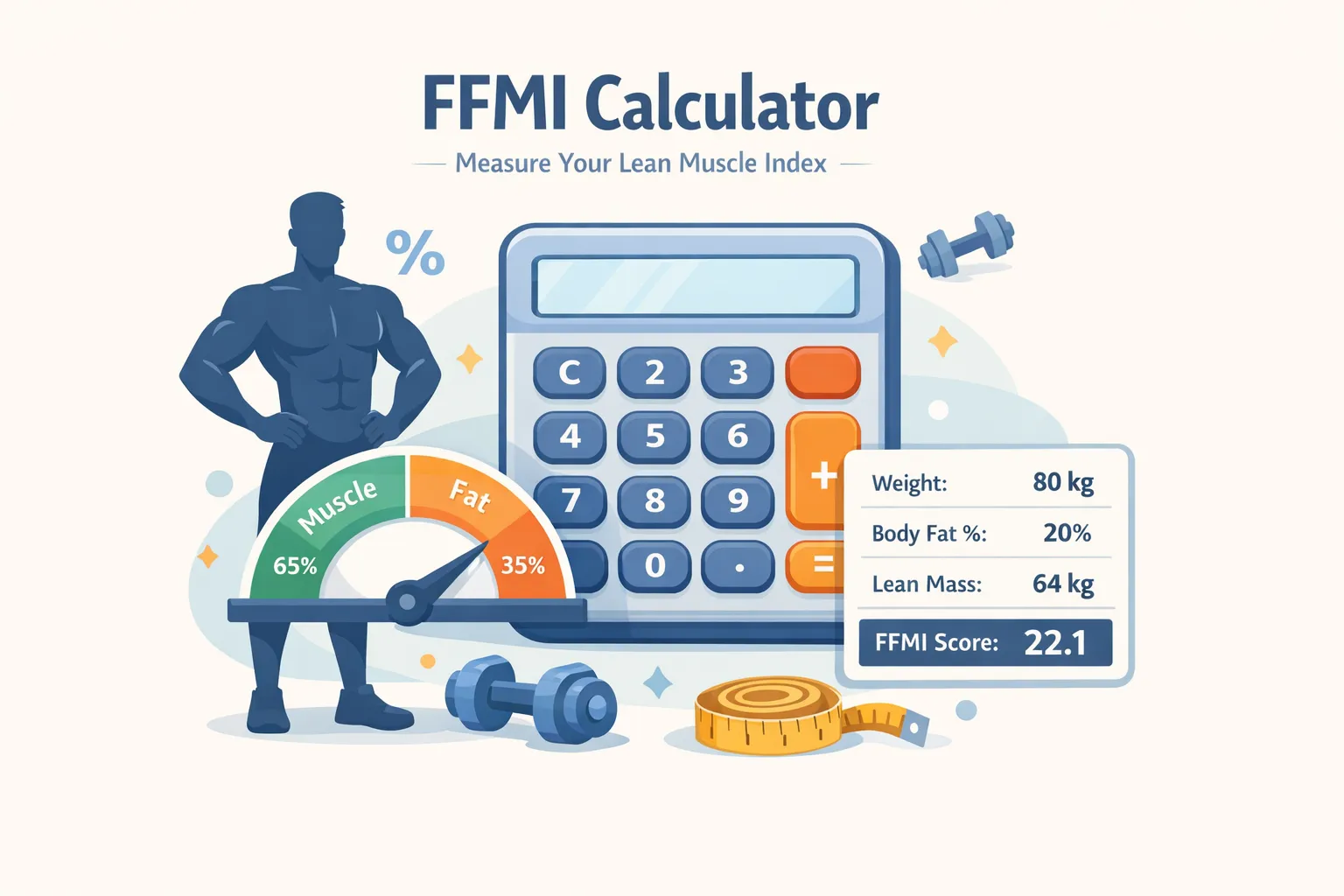
Our FFMI calculator features a unique interactive body visualization system that provides instant visual feedback as you adjust your measurements. This innovative feature helps you understand what different FFMI scores actually look like in terms of muscle development and body composition.
How the Visualization Works
- Real-time Updates: The body silhouette changes instantly as you modify your height, weight, or body fat percentage
- Gender-Specific Models: Separate visualizations for male and female body types with accurate proportions
- Progressive Muscle Definition: Visual muscle definition increases as FFMI score improves from skinny to elite
- Body Type Labels: Clear categorization (Skinny, Average, Fit, Muscular, Elite) with color-coded indicators
- Progress Bar: Visual progress indicator showing where you fall on the FFMI spectrum
This visual representation makes it easier to set realistic fitness goals and track your progress over time. Whether you're just starting your fitness journey or you're an experienced athlete, seeing your body type visualized helps you understand where you are and where you can go.
What Is FFMI (Fat-Free Mass Index)?
FFMI (Fat-Free Mass Index) is a measurement that assesses your muscle mass relative to your height, similar to how BMI measures overall body mass. However, unlike BMI, FFMI specifically accounts for body fat percentage, making it a far more accurate indicator of muscle development and body composition.
The FFMI was developed by researchers Kouri et al. in 1995 as a way to assess muscle mass in athletes and bodybuilders. It's particularly useful for determining natural genetic potential for muscle growth and identifying whether someone's physique is achievable naturally or may involve performance-enhancing substances.
Why FFMI Matters:
- • Accurately measures muscle mass independent of body fat
- • Accounts for height differences between individuals
- • Helps track muscle-building progress over time
- • Identifies natural genetic potential limits
- • More useful than BMI for athletes and fitness enthusiasts
FFMI Formula Explained
The FFMI calculation involves three main steps. Understanding the formula helps you appreciate what the number actually represents:
Step 1: Calculate Lean Body Mass
This determines how much of your total weight is muscle, bone, organs, and water (everything except fat).
Step 2: Calculate FFMI
This adjusts your lean mass for your height, similar to how BMI works, allowing fair comparison between people of different heights.
Step 3: Calculate Normalized FFMI (Optional)
This further adjusts for height by normalizing all scores to 1.8 meters (5'11"), making comparisons even more accurate across different heights.
FFMI Chart & Interpretation
FFMI scores are interpreted differently for men and women due to biological differences in muscle mass potential. Here's how to understand your score:
👨 Men's FFMI Ranges
👩 Women's FFMI Ranges
Natural Genetic Limit:
Research suggests that most natural athletes reach an FFMI of 25 for men and 22 for women. Scores consistently above these levels may indicate enhanced performance, though genetics, training history, and measurement accuracy all play important roles.
How to Calculate FFMI
Calculating your FFMI requires three key measurements: height, weight, and body fat percentage. Here's a comprehensive guide to getting accurate measurements and performing the calculation:
Step 1: Measure Your Height
Measure your height accurately without shoes. Stand straight against a wall and use a measuring tape or stadiometer. Record in either feet/inches or centimeters.
Step 2: Measure Your Weight
Weigh yourself in the morning after using the bathroom but before eating. Use a digital scale for accuracy. Record in pounds or kilograms.
Step 3: Determine Body Fat Percentage
Body fat percentage is the most challenging measurement. Here are methods ranked by accuracy:
Most Accurate Methods
- 1. DEXA Scan: Gold standard, ±1-2% error
- 2. Hydrostatic Weighing: Very accurate, ±2-3% error
- 3. Bod Pod: Air displacement, ±2-3% error
Practical Methods
- 4. Skinfold Calipers: Affordable, ±3-5% error with practice
- 5. Bioelectrical Impedance: Convenient, ±4-6% error
- 6. Visual Estimation: Free, ±5-8% error
Step 4: Use This Calculator
Once you have your measurements, simply enter them into this calculator. It will automatically:
- Calculate your lean body mass
- Compute your FFMI score
- Calculate normalized FFMI for height adjustment
- Determine your category (Below Average to Elite)
- Provide personalized insights and recommendations
Pro Tip:
For tracking progress over time, use the same measurement method consistently. Even if the absolute accuracy isn't perfect, consistent measurements will show reliable trends in your muscle development.
FFMI vs BMI: Which Is Better?
While both FFMI and BMI use height and weight measurements, they serve very different purposes and have distinct advantages and limitations. Understanding the differences helps you choose the right metric for your goals.
FFMI (Fat-Free Mass Index)
What it measures:
Muscle mass relative to height, accounting for body fat
Requires:
Height, weight, and body fat percentage
Best for:
Athletes, bodybuilders, fitness enthusiasts tracking muscle development
Advantages:
- • Distinguishes muscle from fat
- • Accurate for muscular individuals
- • Tracks muscle-building progress
- • Identifies natural genetic limits
BMI (Body Mass Index)
What it measures:
Total body mass relative to height
Requires:
Only height and weight
Best for:
General population health screening, quick assessments
Limitations:
- • Doesn't distinguish muscle from fat
- • Inaccurate for athletes
- • Can misclassify muscular people as overweight
- • Doesn't reflect body composition
Real-World Example
Consider two individuals, both 5'10" (178 cm) and 200 lbs (91 kg):
Person A: Athlete
- • Body Fat: 12%
- • BMI: 28.7 (Overweight)
- • FFMI: 24.5 (Excellent)
- • Reality: Very muscular, healthy
Person B: Sedentary
- • Body Fat: 30%
- • BMI: 28.7 (Overweight)
- • FFMI: 19.5 (Average)
- • Reality: High body fat, low muscle
BMI gives both the same "overweight" classification, while FFMI correctly identifies Person A as highly muscular and Person B as having average muscle mass with high body fat.
Bottom Line:
Use FFMI if you're tracking muscle development, training seriously, or have above-average muscle mass. Use BMI for quick general health screening when body composition details aren't critical. For the most complete picture, track both metrics along with body fat percentage.
FFMI Calculation Formula
The FFMI calculator uses these formulas to assess muscle mass:
- Lean Body Mass = Weight × (1 - Body Fat % ÷ 100)
- FFMI = Lean Mass (kg) ÷ (Height in meters)²
- Normalized FFMI = FFMI + (6.1 × (1.8 - Height in meters))
- Fat Mass = Total Weight - Lean Body Mass
Example FFMI Calculation
Male, 180 lbs (82 kg), 5'10" (178 cm), 15% body fat:
Frequently Asked Questions
What is a good FFMI score?
For men, an FFMI of 18-20 is average, 20-22 is fit, 22-25 is excellent, and 25+ is elite. For women, 15-17 is average, 17-19 is fit, 19-22 is excellent, and 22+ is elite. Most natural athletes have an FFMI between 18-25.
Is FFMI better than BMI?
Yes, FFMI is generally more accurate than BMI for assessing body composition because it accounts for body fat percentage and specifically measures muscle mass. BMI doesn't distinguish between muscle and fat, making it less useful for athletes and fitness enthusiasts.
Can FFMI be too high?
An FFMI above 25 for men or 22 for women is considered elite and approaching natural genetic limits. FFMI scores consistently above 26-27 may indicate enhanced performance, though genetics, training history, and measurement accuracy all play roles.
How accurate is FFMI?
FFMI accuracy depends on the accuracy of your body fat percentage measurement. Using methods like DEXA scans or hydrostatic weighing provides the most accurate results. Estimates from calipers or bioelectrical impedance may have 3-5% error margins.
What is normalized FFMI?
Normalized FFMI adjusts the standard FFMI to account for height differences, allowing fair comparison between individuals of different heights. It normalizes all scores to a height of 1.8 meters (5'11"), making it easier to compare muscle mass across populations.
How can I improve my FFMI?
To improve FFMI, focus on building lean muscle mass through progressive resistance training, consuming adequate protein (1.6-2.2g per kg body weight), maintaining a caloric surplus or maintenance, and getting sufficient recovery. Consistency over months and years is key.
What's the difference between FFMI and lean body mass?
Lean body mass is the absolute amount of muscle, bone, and organs (everything except fat) in kilograms or pounds. FFMI is an index that adjusts lean mass for height, similar to how BMI adjusts weight for height, making it useful for comparing individuals of different sizes.
Is FFMI the same for men and women?
No, men and women have different FFMI ranges due to biological differences in muscle mass potential. Men naturally have higher FFMI scores (average 18-20) compared to women (average 15-17) due to hormonal differences, particularly testosterone levels.
Can I calculate FFMI without knowing body fat percentage?
No, body fat percentage is essential for calculating FFMI because you need to determine lean body mass first. If you don't know your body fat percentage, you can estimate it using visual comparison charts, calipers, or bioelectrical impedance scales, though accuracy will vary.