What is a HELOC?
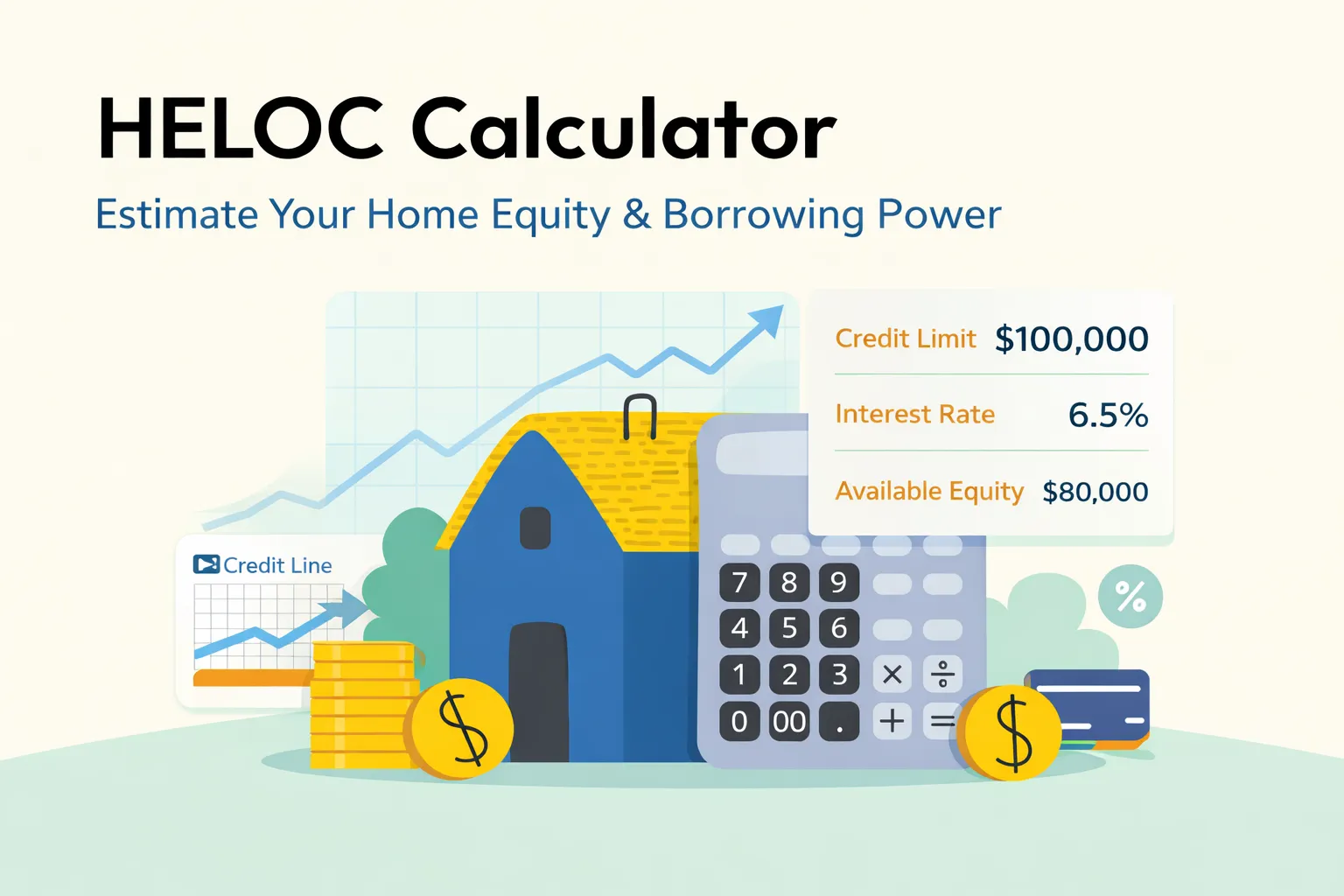
A Home Equity Line of Credit (HELOC) is a revolving credit line secured by your home's equity. Unlike a traditional home equity loan that provides a lump sum, a HELOC works like a credit card—you can borrow, repay, and borrow again up to your credit limit during the draw period.
HELOCs typically have two distinct phases: the draw period (usually 10 years) where you can borrow money and make interest-only payments, and the repayment period (usually 15-20 years) where you must repay both principal and interest. This HELOC payment calculator helps you understand costs in both phases.
Most lenders allow you to borrow up to 85% of your home's value minus your mortgage balance. For example, with a $400,000 home and $200,000 mortgage, you could access up to $140,000 in equity. Use this free HELOC calculator to determine your available equity and monthly payments.
Key Benefit:
HELOCs offer flexibility—you only pay interest on what you borrow, and you can access funds as needed during the draw period.
How to Calculate HELOC Payment
Calculating HELOC payments requires understanding two different payment structures. This HELOC monthly payment calculator automates both calculations for you:
Interest-Only Payment (Draw Period)
During the draw period, most HELOCs require only interest payments. The formula is simple:
Example: $80,000 HELOC at 7.5% = ($80,000 × 0.075) ÷ 12 = $500/month
Principal + Interest Payment (Repayment Period)
After the draw period ends, you must repay both principal and interest using standard amortization:
Where P = principal, r = monthly interest rate, n = number of months
This HELOC repayment calculator handles all the complex math automatically, showing you exactly what to expect in each phase.
Interest-Only HELOC Payments Explained
Interest-only payments are a defining feature of HELOCs during the draw period. Understanding how they work is crucial for budgeting and long-term planning.
✅ Advantages
- • Lower monthly payments during draw period
- • Maximum cash flow flexibility
- • Only pay for what you borrow
- • Can make principal payments anytime
- • Ideal for short-term financing needs
⚠️ Disadvantages
- • Principal balance doesn't decrease
- • Payment shock when repayment starts
- • More total interest paid over time
- • Variable rates can increase payments
- • Temptation to overborrow
Example: A $100,000 HELOC at 8% interest costs $667/month interest-only. When the repayment period begins, the payment jumps to approximately $836/month (assuming 20-year repayment), a 25% increase.
Use this interest-only HELOC calculator to see your exact payment increase and plan accordingly. Many homeowners make voluntary principal payments during the draw period to reduce the repayment phase shock.
HELOC Amortization Schedule
A HELOC amortization schedule shows how your payments are applied to principal and interest over the life of the loan. Unlike traditional mortgages, HELOC amortization has two distinct phases:
Phase 1: Draw Period (Years 1-10)
- 100% of payment goes to interest
- Principal balance remains unchanged
- Can borrow additional funds up to credit limit
- Payments stay consistent (unless rates change)
Phase 2: Repayment Period (Years 11-30)
- Payment split between principal and interest
- Principal balance decreases each month
- Cannot borrow additional funds
- Payments significantly higher than draw period
This HELOC amortization calculator generates a complete payment schedule showing exactly how much goes to principal vs. interest each month. Understanding your amortization helps you make informed decisions about extra payments and refinancing.
HELOC vs Home Equity Loan: Which is Better?
Both HELOCs and home equity loans tap into your home's equity, but they work very differently. Here's a comprehensive comparison:
| Feature | HELOC | Home Equity Loan |
|---|---|---|
| Structure | Revolving credit line | Lump sum loan |
| Interest Rate | Variable (typically) | Fixed ✅ |
| Payment Structure | Interest-only, then P+I | Consistent P+I ✅ |
| Flexibility | High - borrow as needed ✅ | Low - one-time funding |
| Best For | Ongoing expenses, renovations | One-time large expense |
| Rate Risk | Higher - rates can increase ⚠️ | None - rate locked ✅ |
Choose a HELOC if: You need ongoing access to funds, want flexibility, have variable expenses (like home renovations), or expect to pay off quickly.
Choose a Home Equity Loan if: You need a specific amount, want payment certainty, prefer fixed rates, or are consolidating debt. For mortgage planning, check our mortgage payoff calculator.
Tips for Managing Your HELOC
💰 During Draw Period
Make voluntary principal payments to reduce repayment phase shock and total interest costs.
- • Pay more than the minimum
- • Track your balance regularly
- • Avoid maxing out your line
📊 Rate Management
Monitor interest rates and consider converting to fixed rate if available when rates are favorable.
- • Watch the prime rate
- • Consider rate caps
- • Explore fixed-rate options
🎯 Strategic Use
Use HELOCs for investments that increase home value or generate returns, not for depreciating assets.
- • Home improvements
- • Education/training
- • Business investments
💡 Plan Ahead
Prepare for the repayment period by budgeting for higher payments 2-3 years before it begins.
- • Build emergency fund
- • Reduce other debt
- • Consider refinancing options
📚 HELOC Resource Hub
Explore our complete HELOC guide collection to make informed decisions:
HELOC Payment on $50,000
Monthly cost breakdown for $50k loans
HELOC Payment on $200,000
Monthly cost breakdown for $200k loans
HELOC Interest Rates (2026)
Current rates by credit score
HELOC vs Home Equity Loan
Compare your borrowing options
Is a HELOC a Good Idea?
Pros, cons, and decision guide
Home Equity Loan Calculator
Compare with fixed-rate loans
HELOC Payment Calculation Formulas
HELOCs have two distinct payment phases with different calculation methods:
- Available Equity = (Home Value × 85%) - Mortgage Balance
- Interest-Only Payment = (Credit Line × Interest Rate) ÷ 12
- Monthly Interest Rate = Annual Rate ÷ 12
- Repayment Payment = P × [r(1+r)^n] ÷ [(1+r)^n - 1]
- Total Interest = (Interest-Only × Draw Months) + (Repayment × Repay Months) - Principal
Example HELOC Calculation
Homeowner with $400,000 home value and $200,000 mortgage balance:
Frequently Asked Questions
How do I calculate my HELOC payment?
HELOC payments are calculated in two phases: (1) Draw Period: Interest-only payment = (loan amount × interest rate) ÷ 12. (2) Repayment Period: Principal + interest using standard amortization formula. This calculator automatically computes both phases for you.
What is the difference between draw period and repayment period?
The draw period (typically 10 years) is when you can borrow money and make interest-only payments. The repayment period (typically 15-20 years) follows, requiring you to pay back both principal and interest. Your monthly payment increases significantly when entering the repayment phase.
How much home equity can I borrow with a HELOC?
Most lenders allow you to borrow up to 85% of your home's value minus your mortgage balance. For example, with a $400,000 home and $200,000 mortgage, you could access up to $140,000 ($400,000 × 0.85 - $200,000). This calculator shows your available equity automatically.
Are HELOC interest rates fixed or variable?
Most HELOCs have variable interest rates tied to the prime rate, meaning your payment can change over time. Some lenders offer fixed-rate options or the ability to convert portions to fixed rates. Always factor in potential rate increases when planning your budget.
Can I pay principal during the draw period?
Yes! While only interest is required during the draw period, you can make additional principal payments to reduce your balance and total interest costs. Paying down principal early can significantly reduce your repayment phase payments.
What happens when the draw period ends?
When the draw period ends, you can no longer borrow additional funds, and you must begin repaying both principal and interest. Your monthly payment typically increases by 50-100% or more. Use this calculator to see exactly how much your payment will increase.
How is a HELOC different from a home equity loan?
A HELOC is a revolving line of credit with variable rates and two payment phases. A home equity loan provides a lump sum with fixed rates and consistent payments. HELOCs offer flexibility but variable payments, while home equity loans provide payment certainty.
What is interest-only payment on a HELOC?
Interest-only payment means you only pay the interest charges each month without reducing the principal balance. For an $80,000 HELOC at 7.5%, the interest-only payment is $500/month ($80,000 × 0.075 ÷ 12). This keeps payments low during the draw period.
How do I calculate HELOC payoff time?
Total payoff time = draw period + repayment period. For a typical HELOC with 10-year draw and 20-year repayment, full payoff takes 30 years. However, you can pay off early by making additional principal payments during either phase.