Introduction to CPM in Digital Advertising
Understanding how much it costs to get your ads seen is essential in digital marketing. CPM (Cost Per Mille) is one of the most widely used metrics for measuring ad visibility and campaign efficiency.
Whether you're running ads on social media, display networks, or video platforms, CPM helps you evaluate how cost-effective your reach is.
What Is CPM (Cost Per Mille)?
CPM stands for Cost Per Mille, meaning the cost you pay for 1,000 impressions of your ad. An impression occurs every time your ad is displayed to a user—whether they click on it or not.
In simple terms:
CPM tells you how much it costs to get your ad seen 1,000 times.
CPM Calculation Formula
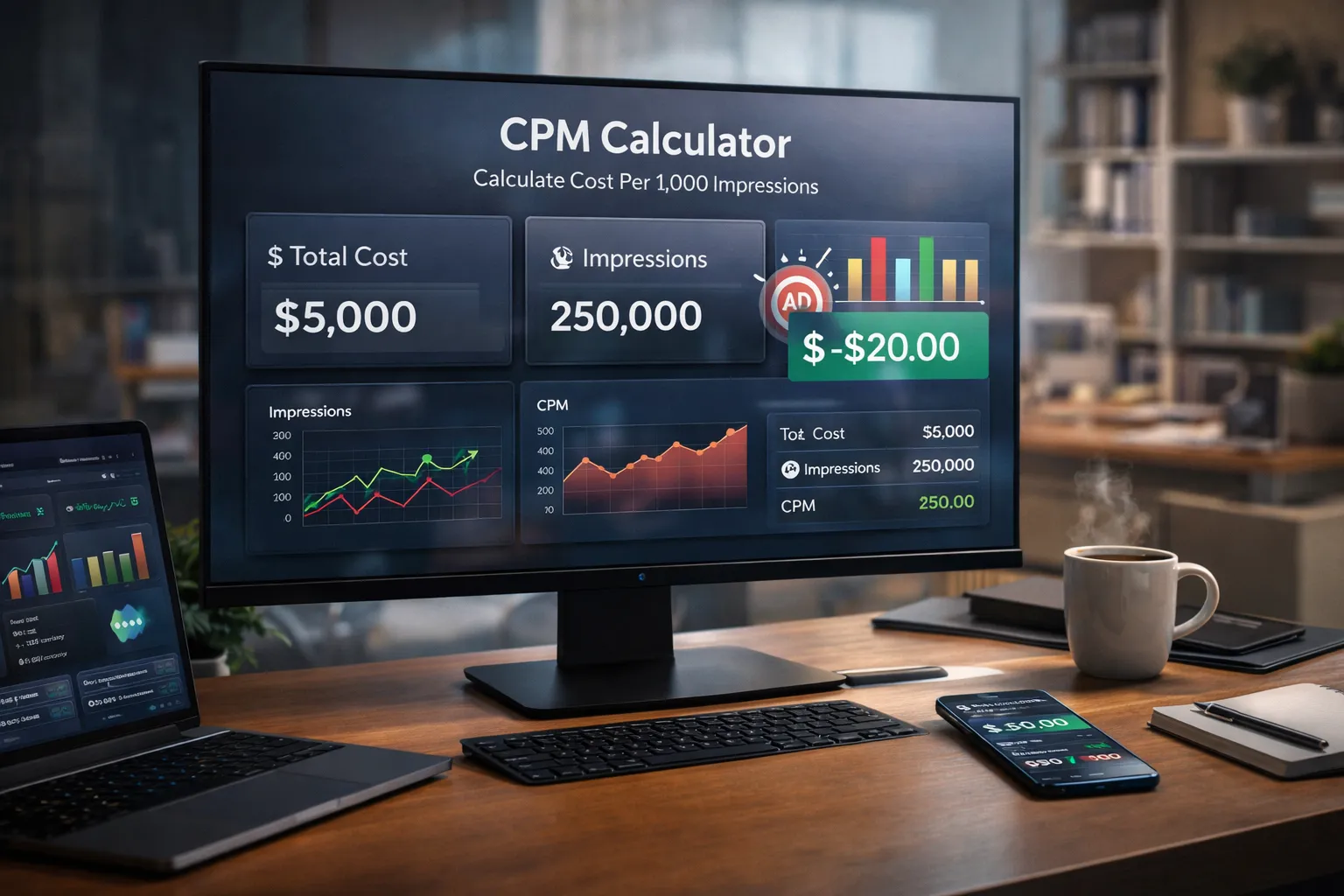
CPM (Cost Per Mille) is calculated using a simple formula to standardize advertising costs:
- CPM = (Cost ÷ Impressions) × 1,000
- Cost = Total amount spent on the campaign
- Impressions = Total number of times your ad was shown
- Reverse: Cost = (CPM × Impressions) ÷ 1,000
- Reverse: Impressions = (Cost × 1,000) ÷ CPM
How to Calculate CPM (Step-by-Step Guide)
Step 1: Determine Your Total Ad Spend
This is your total budget for a campaign.
Step 2: Track Impressions
The number of times your ad appears on users' screens.
Step 3: Apply the Formula
Divide your cost by impressions, then multiply by 1,000.
Common Mistakes to Avoid
- Using estimated impressions instead of actual data
- Forgetting to multiply by 1,000
- Comparing CPM across very different audiences
Example CPM Calculation
Calculate CPM for a social media advertising campaign:
Reverse CPM Calculations
Sometimes, you need to calculate cost or impressions instead of CPM.
Calculate Cost from CPM
Formula: Cost = (CPM × Impressions) ÷ 1,000
Example:
- CPM = $8
- Impressions = 200,000
- Cost = $1,600
Calculate Impressions from Budget
Formula: Impressions = (Cost × 1,000) ÷ CPM
Example:
- Budget = $500
- CPM = $5
- Impressions = 100,000
What Is a Good CPM? (Benchmarks by Platform)
A "good" CPM varies depending on your platform and audience targeting.
Average CPM Benchmarks
| Platform | Average CPM Range |
|---|---|
| Social Media Ads | $5 – $12 |
| Display Ads | $2 – $10 |
| Video Ads | $4 – $15 |
| Professional Networks | $20+ |
Remember:
Lower CPM = cheaper reach
Higher CPM = more competitive audience
What Factors Affect CPM?
Several variables influence how much you pay:
- Target audience (location, interests, demographics)
- Competition level in your industry
- Ad quality and relevance
- Platform choice
- Seasonality (costs increase during peak periods)
CPM vs CPC vs CPA (Key Differences)
Understanding these metrics helps you choose the right strategy:
- CPM → Pay for impressions (visibility)
- CPC (Cost Per Click) → Pay for clicks (traffic)
- CPA (Cost Per Acquisition) → Pay for conversions (results)
Use CPM when your goal is brand awareness.
When Should You Use CPM?
CPM works best when:
- You want maximum exposure
- You're building brand awareness
- You're running display or video campaigns
- You're targeting top-of-funnel audiences
How to Lower Your CPM (Proven Strategies)
Reducing CPM improves your campaign efficiency significantly.
1. Improve Ad Quality
- Use high-quality visuals
- Write compelling headlines
- Add strong hooks
2. Refine Targeting
- Avoid overly broad audiences
- Use lookalike or custom audiences
- Exclude irrelevant users
3. Test Multiple Creatives
- A/B test images and videos
- Experiment with ad formats
4. Optimize Placements
- Try different platforms and placements
- Compare mobile vs desktop
5. Increase Engagement
Higher engagement signals → lower costs
Real Case Study Example
A brand reduced CPM by over 40% by:
- Switching to video ads
- Improving targeting
- Enhancing ad copy
Result:
Lower costs + higher engagement
Frequently Asked Questions
What is CPM in advertising?
CPM (Cost Per Mille) is the cost you pay for every 1,000 ad impressions. An impression occurs each time your ad is displayed to a user, whether they click on it or not. CPM is a standard metric used to measure ad visibility and campaign efficiency across digital advertising platforms.
How do you calculate CPM?
To calculate CPM, divide your total campaign cost by total impressions, then multiply by 1,000. Formula: CPM = (Cost ÷ Impressions) × 1,000. For example, if you spend $500 for 100,000 impressions, your CPM is ($500 ÷ 100,000) × 1,000 = $5.
What is a good CPM rate?
A good CPM varies by platform and industry. Average benchmarks: Social media ads $5-$12, Display ads $2-$10, Video ads $4-$15, Professional networks $20+. Lower CPM means cheaper reach, but quality matters more than just low cost. Consider engagement and conversion rates alongside CPM.
Is a lower CPM always better?
No, a lower CPM isn't always better. While it means cheaper reach, you must consider ad quality, engagement, and conversions. A $3 CPM with 0.1% engagement is worse than a $10 CPM with 2% engagement. Focus on cost per result (CPA) rather than just CPM.
What's the difference between CPM and CPC?
CPM (Cost Per Mille) charges for impressions—you pay for ad views. CPC (Cost Per Click) charges for clicks—you pay only when users click your ad. Use CPM for brand awareness campaigns and CPC for direct response campaigns focused on traffic and conversions.
How can I lower my CPM?
Lower CPM by: (1) Improving ad quality with better visuals and copy, (2) Refining audience targeting to avoid waste, (3) A/B testing multiple creatives, (4) Optimizing ad placements, (5) Increasing engagement rates, (6) Avoiding peak competition times, (7) Using video content which often has better engagement.
Why is CPM important?
CPM is important because it helps measure how efficiently your ads reach your audience. It allows you to compare costs across different platforms, campaigns, and time periods. CPM is essential for budgeting, forecasting reach, and optimizing brand awareness campaigns.
When should I use CPM bidding?
Use CPM bidding when your goal is maximum exposure and brand awareness, not direct conversions. CPM works best for: top-of-funnel campaigns, display and video ads, retargeting campaigns, new product launches, and when you want to reach as many people as possible within your target audience.
How do I calculate cost from CPM?
To calculate cost from CPM, use the formula: Cost = (CPM × Impressions) ÷ 1,000. For example, if your CPM is $8 and you want 200,000 impressions, the cost would be ($8 × 200,000) ÷ 1,000 = $1,600. This helps with budget planning.