How Much Do I Need to Retire?
The amount you need to retire depends on your desired lifestyle, expected expenses, and retirement age. Financial experts typically recommend saving 10-12 times your annual income by retirement age. For example, if you earn $75,000 per year, you should aim for $750,000 to $900,000 in retirement savings.
The popular "4% rule" suggests you can safely withdraw 4% of your retirement savings annually without running out of money. Using this rule, $1 million in savings would provide $40,000 per year in retirement income. According to the Social Security Administration, the average Social Security benefit is about $1,900/month ($22,800/year), so your personal savings need to fill the gap.
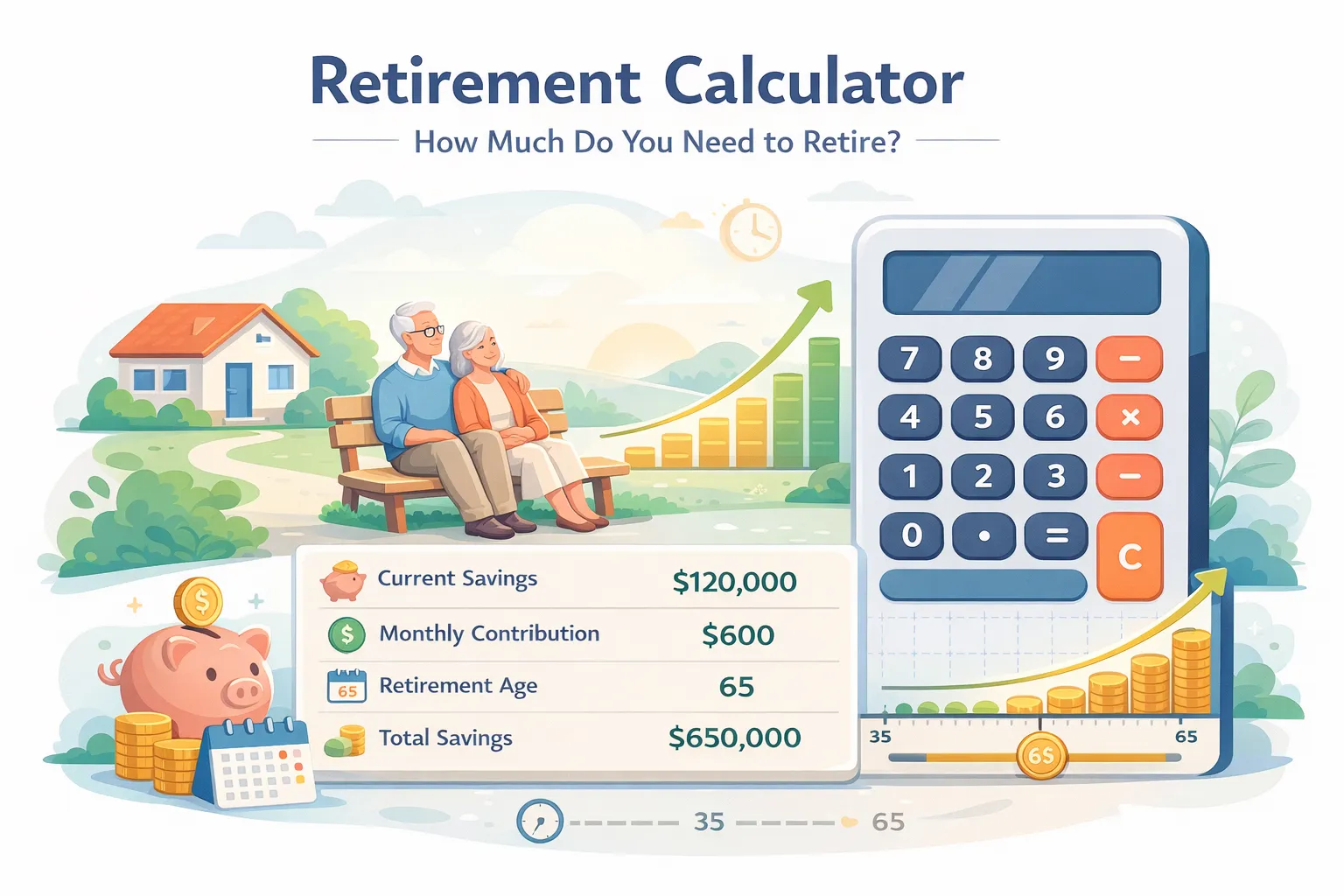
Use our retirement calculator above to determine your specific needs based on your current age, savings, and contribution rate. The calculator shows how compound interest can dramatically grow your investments over time, making early and consistent saving crucial for retirement success.
Quick Rule of Thumb:
Multiply your desired annual retirement income by 25. If you want $60,000/year, you need $1.5 million saved ($60,000 × 25).
How Much Should I Save for Retirement Each Month?
Financial advisors typically recommend saving 15-20% of your gross income for retirement. This includes employer contributions to your 401(k). If you earn $60,000 per year, that's $750-$1,000 per month toward retirement.
| Annual Income | 15% Savings | 20% Savings | Monthly (15%) |
|---|---|---|---|
| $40,000 | $6,000 | $8,000 | $500 |
| $60,000 | $9,000 | $12,000 | $750 |
| $80,000 | $12,000 | $16,000 | $1,000 |
| $100,000 | $15,000 | $20,000 | $1,250 |
Start with employer match: Always contribute enough to get your full employer 401(k) match—it's free money with an instant 100% return. If your employer matches 50% up to 6% of salary, contribute at least 6% to get the full match.
If 15-20% seems impossible, start with what you can afford and increase by 1% annually. Even small contributions grow significantly over time thanks to compound interest. Use our retirement savings calculator to see how different contribution amounts affect your retirement nest egg.
Retirement Savings Calculation Formula
Our calculator uses compound interest formulas to project retirement savings:
- Future Value of Current Savings = Current Balance × (1 + r)^n
- Future Value of Contributions = Monthly × [((1 + r)^n - 1) / r]
- Where r = Annual Return / 12 (monthly rate)
- Where n = (Retirement Age - Current Age) × 12 (months)
- Total Retirement Savings = FV of Savings + FV of Contributions
Example Retirement Calculation
40-year-old with $40,000 saved, contributing $1,000/month at 7% annual return:
Frequently Asked Questions
How much do I need to retire?
Most financial experts recommend saving 10-12 times your annual income by retirement age. For example, if you earn $75,000/year, aim for $750,000-$900,000 in retirement savings. The 4% rule suggests you can withdraw 4% annually ($30,000-$36,000) without depleting your savings. Your actual needs depend on lifestyle, healthcare costs, and other income sources like Social Security.
How much should I save for retirement each month?
Financial advisors typically recommend saving 15-20% of your gross income for retirement. If you earn $60,000/year, that's $750-$1,000/month. Start with your employer's 401(k) match (free money!), then increase contributions annually. The earlier you start, the less you need to save monthly due to compound growth.
What is a good rate of return for retirement savings?
Historically, the S&P 500 has averaged 10% annual returns, but a conservative estimate of 6-8% is more realistic for retirement planning after accounting for inflation and fees. Younger investors can assume 7-8% with aggressive portfolios, while those near retirement should use 5-6% with conservative allocations. Always plan conservatively.
Can I retire early?
Yes, but it requires aggressive saving and careful planning. To retire at 55 instead of 65, you need to save significantly more since your money must last longer and has less time to grow. Consider the FIRE (Financial Independence, Retire Early) movement strategies: save 50-70% of income, minimize expenses, and invest aggressively. Use our Coast FIRE calculator to explore early retirement options.
How does compound interest affect retirement savings?
Compound interest is your most powerful retirement tool. Money invested early has decades to grow exponentially. For example, $10,000 invested at age 25 at 8% becomes $217,000 by age 65. The same $10,000 invested at age 45 only grows to $46,600. Time in the market beats timing the market—start saving early!
Should I pay off debt or save for retirement?
Do both, but prioritize high-interest debt (credit cards over 10%) first. Always contribute enough to get your full employer 401(k) match—that's an instant 100% return. Then tackle high-interest debt. For low-interest debt (mortgages under 4%), continue retirement contributions since investment returns typically exceed the interest rate.
What if I'm behind on retirement savings?
Don't panic—take action now. Increase contributions by 1-2% annually, maximize catch-up contributions after age 50 ($7,500 extra for 401(k)s in 2024), delay retirement by a few years, reduce expenses, and consider working part-time in retirement. Even starting at 50, consistent saving can build a substantial nest egg.
How much will Social Security pay me?
The average Social Security benefit in 2024 is about $1,900/month ($22,800/year). Your actual benefit depends on your earnings history and claiming age. Claiming at 62 reduces benefits by 30%, while waiting until 70 increases them by 24%. Visit SSA.gov to get your personalized estimate. Don't rely solely on Social Security—it typically replaces only 40% of pre-retirement income.
What's the difference between 401(k), IRA, and Roth IRA?
401(k): Employer-sponsored, $23,000 limit (2024), often with employer match, tax-deferred growth. Traditional IRA: Individual account, $7,000 limit (2024), tax-deductible contributions, taxed at withdrawal. Roth IRA: After-tax contributions, tax-free growth and withdrawals, income limits apply. Strategy: Max employer match first, then Roth IRA, then max 401(k).